Pentagon Launches Review of US Military Posture in Europe as NATO Spending Pressure Grows
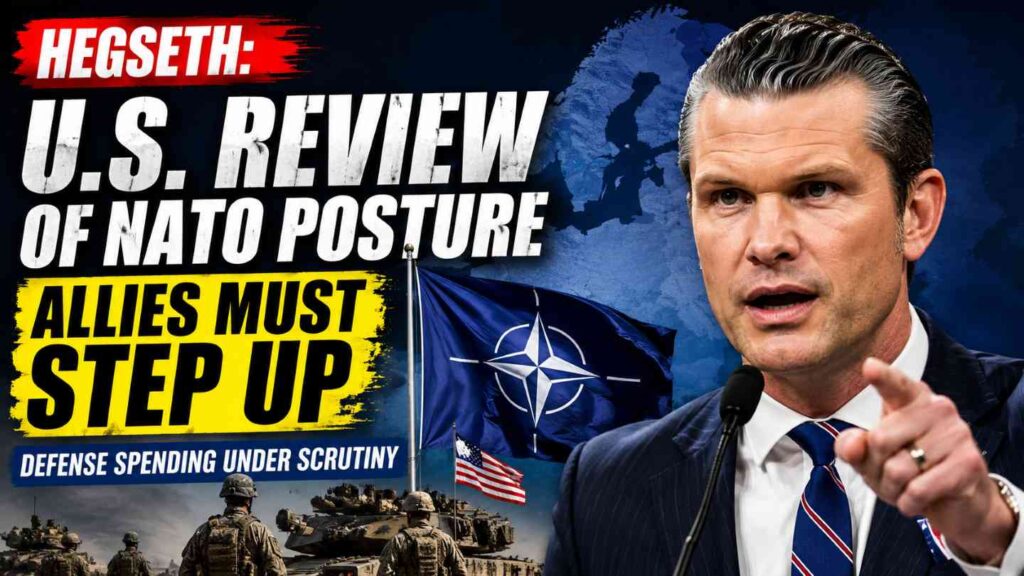
Pentagon Launches Review of US Military Posture in Europe as NATO Spending Pressure Grows
Hegseth Signals New Assessment of Alliance Commitments and Regional Security Strategy
Defense Secretary Pete Hegseth announced that the Pentagon will undertake a review of America’s military posture in Europe, while continuing to press NATO allies to increase defense spending and meet alliance commitments.
Speaking following meetings with NATO leaders, Hegseth said the review will be conducted in coordination with Congress, military commanders, and allied governments. The assessment is expected to examine whether U.S. force deployments across Europe remain aligned with current security needs and the contributions being made by NATO member states.
The announcement comes as the Trump administration continues to emphasize burden-sharing within the alliance, arguing that collective security requires all member nations to invest adequately in their own defense capabilities.
NATO Allies Face Renewed Pressure on Defense Spending
During his remarks, Hegseth reiterated the administration’s long-standing position that NATO members should fulfill agreed-upon defense spending targets.
He said many allied governments have responded positively to calls for increased military investment and have pledged to meet their obligations. However, he noted that some countries remain below established targets, adding that the Pentagon’s review will consider how the United States approaches its security commitments in Europe moving forward.
The defense secretary emphasized that the administration views defense spending as a key measure of alliance participation and readiness.
European Security Review Underway
According to Hegseth, the review will involve consultations with military leadership, including officials at U.S. European Command, as well as discussions with NATO partners.
While he did not outline specific changes under consideration, the assessment could influence future decisions regarding troop deployments, military infrastructure, and security cooperation across the continent.
The administration has repeatedly argued that a stronger NATO depends on increased contributions from European member states, particularly as security challenges continue to evolve.
International Cooperation on Strait of Hormuz Security
Hegseth also addressed efforts to restore and maintain safe navigation through the Strait of Hormuz, one of the world’s most important maritime trade routes.
He welcomed participation from European and Asian countries in efforts to identify and remove naval mines and support the reopening of commercial shipping lanes. Hegseth said international cooperation would be essential to ensuring stability in the region and maintaining global trade flows.
The defense secretary noted that many countries depend heavily on energy shipments passing through the waterway and therefore have a strong interest in helping secure the route.
Administration Maintains Firm Position on Iran
A significant portion of Hegseth’s remarks focused on Iran and ongoing efforts to prevent the country from developing nuclear weapons capabilities.
He stated that the administration’s approach is centered on ensuring that Iran does not obtain a nuclear weapon and said any future arrangements would require strict verification measures.
According to Hegseth, U.S. military and diplomatic efforts are designed to encourage compliance while maintaining the ability to respond if commitments are not met. He stressed that verification would remain a central component of any agreement or framework involving Iran’s nuclear activities.
The administration has repeatedly stated that preventing nuclear proliferation in the region remains a top national security priority.
U.S.-U.K. Defense Partnership Remains Key
Hegseth also discussed meetings with his British counterpart, describing the U.S.-United Kingdom defense relationship as one of the most important partnerships within NATO.
He encouraged continued increases in defense spending and highlighted the importance of maintaining access to strategic military facilities and bases that support joint operations.
The defense secretary said stronger defense cooperation between Washington and London would benefit NATO as a whole and contribute to broader Western security objectives.
Future Decisions Will Be Performance-Based
Throughout his remarks, Hegseth repeatedly emphasized that future decisions regarding military posture, alliance commitments, and regional security initiatives would be guided by measurable results.
He said the administration intends to evaluate commitments based on performance, compliance, and verification rather than assumptions or promises.
As the Pentagon begins its review of U.S. military deployments in Europe, NATO allies are expected to face continued pressure to strengthen defense spending and demonstrate their commitment to the alliance’s long-term security goals.
The review could play a significant role in shaping future U.S. strategy in Europe while reinforcing the administration’s focus on accountability, burden-sharing, and collective defense.
#NATO #PeteHegseth #Pentagon #DefenseSpending #EuropeanSecurity #USMilitary #TrumpAdministration #Iran #StraitOfHormuz #NationalSecurity