Iran Under Pressure as Expert Says “The Ship Has Sailed” on MoU
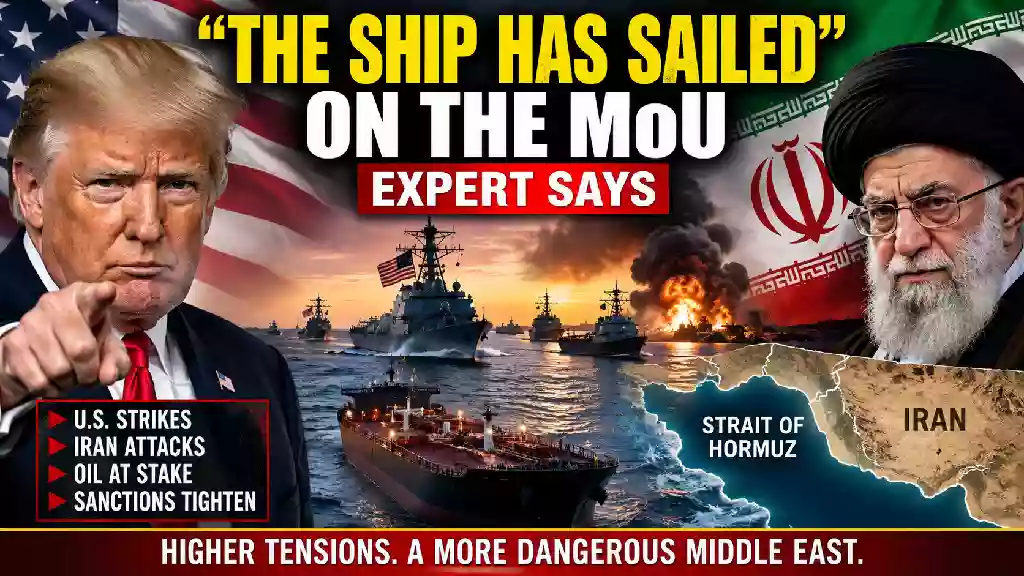
U.S.-Iran tensions escalate as an expert says “the ship has sailed” on the MoU, with the Strait of Hormuz and regional security at the center of the crisis.
Iran Under Pressure as Expert Says “The Ship Has Sailed” on MoU
US Pressure on Iran Intensifies
The confrontation between the United States and Iran is entering another tense phase as military strikes, economic sanctions and disputes over the Strait of Hormuz continue to shape the conflict.
A recent discussion featuring Major John Spencer, executive director of the Urban Warfare Institute, focused on the growing pressure facing Tehran and whether diplomacy can still produce a meaningful agreement.
Spencer offered a blunt assessment of the situation, saying that “the ship has sailed” on the memorandum of understanding (MoU) and suggesting that Iran’s leadership could ultimately face pressure to capitulate.
The remarks come as U.S. and Iranian forces have exchanged attacks and tensions surrounding commercial shipping in the Strait of Hormuz remain high. Recent reporting also indicates that the earlier interim agreement has broken down amid disagreements over its implementation.
Strait of Hormuz at the Center of the Conflict
One of the most important flashpoints remains the Strait of Hormuz, a vital route for global energy shipments.
The source describes U.S. forces protecting commercial shipping while responding to Iranian missile and drone activity. It also says American forces targeted Iranian air defense systems, radar installations, communications sites and capabilities reportedly connected to laying mines in the waterway.
The strategic importance of the strait has made maritime security a central issue in the confrontation. Recent reporting, however, indicates that shipping activity remains well below normal levels, showing that the waterway continues to face significant disruption despite claims of increased oil movement.
Iran’s Attacks Raise Regional Concerns
The source also reports that Iran launched missiles and drones toward Kuwait, triggering alarms and sending people into shelters. Kuwait reportedly condemned the attack as a violation of its sovereignty.
The incident reflects the broader regional consequences of the U.S.-Iran confrontation. Military exchanges involving Gulf states and attacks connected to commercial shipping could increase the risk of a wider conflict.
President Donald Trump has also warned that the United States is prepared to respond to further Iranian attacks, according to the discussion.
Economic Sanctions Add More Pressure
Military operations are only one part of the strategy described in the discussion. Economic pressure is also being used to restrict Iran’s ability to finance its government and international networks.
The source describes Treasury Secretary Scott Bessent as leading efforts to sever financial connections supporting the Iranian regime. It specifically cites sanctions against Dubai branches of an Egyptian bank that allegedly provided more than $1.8 billion to Iran since 2025.
The discussion further states that the European Union was joining the broader economic pressure campaign, potentially increasing the financial strain on Tehran.
Expert Points to Iran’s Weakening Economy
Spencer argued that several developments indicate the pressure campaign is affecting Iran.
He pointed to economic problems, including severe inflation and a dramatically weakened Iranian currency, as evidence of growing pressure on the regime. He also cited pressure on Iran’s regional proxies and the continued struggle over control of the Strait of Hormuz.
According to Spencer, these factors are combining to reduce Iran’s strategic options.
He ultimately argued that the situation had moved beyond the point where the existing MoU could provide a straightforward solution, saying “the ship has sailed” and suggesting that the Iranian regime may eventually be forced toward capitulation.
U.S. Targets Iran’s Supply Routes
Another major element discussed is Iran’s ability to resupply its military forces.
Spencer said U.S. operations have targeted roads, railway lines and transportation routes that could be used to move equipment into Iran. He described Tehran as facing difficulties obtaining supplies while countries including Russia and China could potentially provide assistance.
The strategy reflects a broader effort to restrict Iran not only at sea but also through its land and air connections.
Could Pressure Lead to Political Change?
The discussion eventually turned toward Iran’s population and the possibility of internal opposition to the Islamic regime.
Spencer acknowledged that an uprising would be extremely dangerous, pointing to the heavy casualties associated with previous unrest. He said protesters would face significant challenges involving communications, protective equipment and security.
He also discussed the possibility of members of Iran’s military refusing to support the regime or potentially siding with protesters, while emphasizing that such a scenario would be highly complex.
What Comes Next for the U.S. and Iran?
The future of U.S.-Iran relations remains uncertain. Military pressure, economic sanctions and the struggle over the Strait of Hormuz have created an increasingly complicated environment for diplomacy.
While Iranian officials have indicated that they remain open to negotiations under certain conditions, the United States has signaled that any future agreement would need to address broader strategic concerns.
For Spencer, the central issue is whether Iran can withstand the mounting pressure or whether the combination of military, economic and strategic measures will force Tehran into a fundamentally different position.
For now, the failed or stalled MoU remains a symbol of how difficult diplomacy has become as the U.S.-Iran confrontation continues.
#Iran #USIran #IranWar #Trump #StraitOfHormuz #MiddleEast #IranConflict #IranSanctions #JohnSpencer #Geopolitics #Kuwait #Oil #BreakingNews